
Overview
Key metrics for Children's Health Queensland Hospital and Health Service's ECHO impact so far.
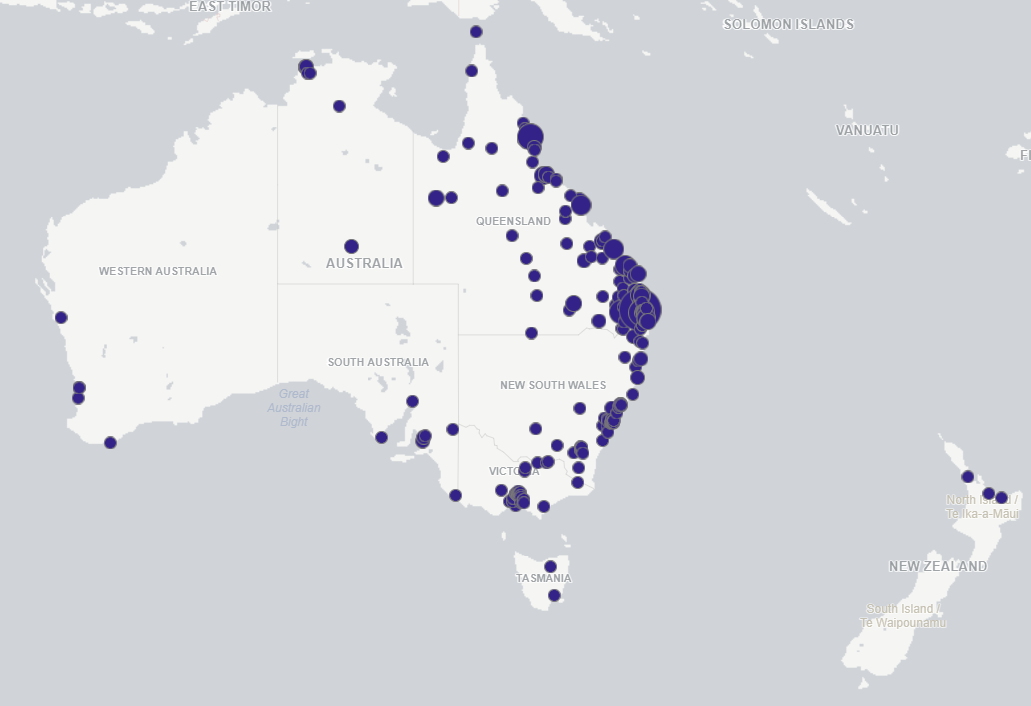
- More than 2,894 frontline providers 426 local communities have accessed advice and support from our specialist ECHO panel teams
- 90 per cent of ECHO participants reported implementing positive changes in their local practices that they attributed to support provided by ECHO networks
- 94 ECHO Networks have been launched, delivering 906 virtual sessions providing free learning and support for frontline providers
- There are 17 individuals on average participating per session
- Project ECHO has also supported frontline child and youth health providers in every state and territory of Australia, and seven other countries
- CHQ’s Project ECHO team has partnered with over 800 other organisations including Child Safety, Education, Youth Justice, National Disability Insurance Agency (NDIA), as well as other Hospital and Health Services (HHS), Primary Health Networks (PHN) and general practices to support frontline professionals where and when they need access to learning, advice, mentorship and professional networks.
- CHQ became the first ECHO hub in Queensland, and Australia’s first child and youth health focused hub in September 2016.
- Thirty organisations across Australia have been licensed, trained and mentored by the Children’s Health Queensland (CHQ) ECHO Superhub to run their own ECHO Networks – including Primary Health Networks (PHN), universities, Hospital and Health Services (HSS) and NGOs.
ECHO Impact Map
Project ECHO - Children, Adolescents and Young Adults with Complex Pain
The success of the Children, Adolescents and Young Adults with Complex Pain ECHO network is testament to the effectiveness of the ECHO model in integrating care throughout Queensland.
View the written abstract [PDF 1238.46 KB] for more detail.
MetaECHO Community Call Presentations
Project ECHO: a global cross-sectional examination of implementation success
Perrin Moss, Program Manager - ECHO Superhub at Children's Health Queensland Hospital and Health Service, and PhD Candidate School of Health and Rehabilitation Sciences, The University of Queensland
Phil Nixon, ECHO Network Coordinator
Publications
- Broccatelli, C., Nixon, P., Moss, P., Baggio, S., Young, A., & Newcomb, D. (2024). Multilevel integrated healthcare: The evaluation of Project ECHO® networks to integrate children’s healthcare in Australia. Social networks, 80, 44-58. https://doi.org/10.1016/j.socnet.2024.08.007
- Nixon, P., Broccatelli, C., Moss, P., Baggio, S., Young, A., & Newcomb, D. (2024). Healthcare social network research and the ECHO model: Exploring a community of practice to support cultural brokers and transfer cultural knowledge. BMC Health Services Research, 24(1), 558. https://doi.org/10.1186/s12913-024-11024-w
- Moss, P., Hartley, N., & Russell, T. (2024). Project ECHO: a global cross-sectional examination of implementation success. BMC Health Services Research, 24(1), 583. https://doi.org/10.1186/s12913-024-10920-5
- Marshall, J., Moss, P., Raatz, M., Ward, E. C., Frederiksen, N., Reilly, C., Dickinson, C., Clarke, S., & Beak, K. (2024). Experiences of Allied Health Clinicians Accessing a Pilot Project ECHO Program to Support Learning in Pediatric Feeding. Journal of Continuing Education in the Health Professions. https://doi.org/10.1097/ceh.0000000000000557
- Moss P, Nixon P, Baggio S, Newcomb D. Turning Strategy into Action – Using the ECHO Model to Empower the Australian Workforce to Integrate Care. International Journal of Integrated Care, 2023; 23(2): 16, 1–14. DOI: https://doi.org/10.5334/ijic.7036
- Moss, P., Hartley, N., Newcomb, D., & Russell, T. (2022). Measuring the Success of a Project ECHO Implementation: Results from an International e-Delphi Study. Global Implementation Research and Applications, 2(3), 179-194. https://doi.org/10.1007/s43477-022-00050-7
- Moss, P., Hartley, N., & Russell, T. (2022). Integration intrapreneurship: implementing innovation in a public healthcare organization. Journal of Innovation and Entrepreneurship, 11(1), 50. https://doi.org/10.1186/s13731-022-00248-x
- Moss P, Nixon P, Newcomb D. Implementation of the first Project ECHO Superhub in Australia. International Journal of Integrated Care, 2021;20(S1):15. http://doi.org/10.5334/ijic.s4015
- Moss, P., Hartley, N., Ziviani, J., Newcomb, D., & Russell, T. (2020). Executive Decision-Making: Piloting Project ECHO to Integrate Care in Queensland. International Journal of Integrated Care, 20(4), 1-15. https://doi.org/10.5334/ijic.5512
- Newcomb, D., Nixon, P., Moss, P., & Kapoor, V. (2022). Supporting GPs in the management of children and young people with ADHD through Project ECHO®: results from a self-efficacy survey. International Journal of Integrated Care, 22(3). https://doi.org/10.5334/ijic.6531
- Raatz, M., Ward, E.C., Moss, P., Reilly, C., Frederiksen, N., Dickinson, C., Clarke, S., Beak, K., & Marshall, J. Examining the Outcomes of Project ECHO® as an Interprofessional Community of Practice for Pediatric Feeding Clinicians. Dysphagia (2023). https://doi.org/10.1007/s00455-023-10603-z